Why Your Business Needs Custom QR Code URLs
Why Your Business Needs Custom QR Code URLs | Black-and-white pixelated squares affixed to product packaging, restaurant tables, and roadside billboards have become a ubiquitous sight. The presence of QR codes has seamlessly bridged the gap between the physical and digital worlds in a matter of seconds. Yet, behind this ultimate convenience lies a burgeoning security loophole that makes modern consumers increasingly hesitant before pointing their smartphone cameras at those pixelated boxes.
When a customer scans a code, the very first thing that appears on their screen is the URL preview. This is the ultimate tipping point. If the emerging link consists of a random string of characters or points to an unfamiliar third-party domain, doubt instantly creeps into their minds: “Is this safe?” or “Am I being lured into a hacker’s trap?”
This fear is well-founded. Cyber threats exploiting QR codes, a phenomenon known as “quishing” (QR code phishing), are steadily on the rise. To combat this crisis of confidence, forward-thinking business owners are shifting toward branded short links or custom domains embedded directly within their dynamic QR codes. This step is far from a mere aesthetic choice; it is a fundamental strategy to establish a fortress of trust and protect brand reputation in the eyes of the consumer.
Understanding the Quishing Threat and Generic Code Vulnerabilities
To fully grasp why URL customization is crucial, it helps to examine how modern cybercriminals operate. In conventional phishing schemes, scammers distribute fraudulent links through emails or text messages. With quishing, however, they exploit the physical nature of the QR code itself. Fraudsters frequently print counterfeit QR code stickers and overlay them directly on top of legitimate codes found in shops, restaurants, or public venues.
When unsuspecting users scan these tampered codes, they are redirected to spoofed websites designed to harvest personal data, steal credit card credentials, or even deploy malicious software onto their mobile devices.
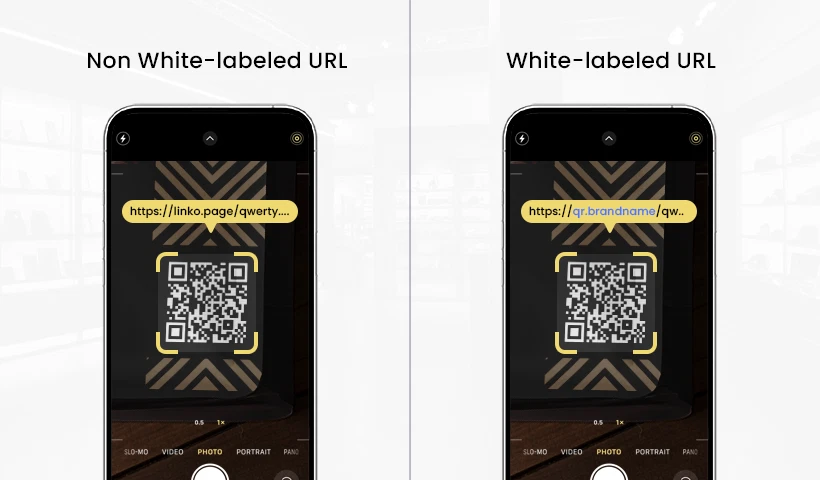
The greatest vulnerability of relying on free or standard out-of-the-box QR code generators is their usage of shared, generic domains. Because these standard domains are public, anyone can use them—including bad actors. Consequently, when everyday users see a generic link preview, they have no reliable way to verify whether that code truly belongs to your company or an underlying scammer. This is precisely where a white-label URL serves as a concrete differentiator.
Core Reasons Businesses Must Customize QR Code URLs
Implementing a dedicated domain within your dynamic QR code infrastructure provides layered security and operational benefits for both your enterprise and your client base. Here is why this transition is essential:
1. Establishing Immediate Peace of Mind
The first reflex of modern smartphone users when scanning a QR code is to glance at the preview text before tapping through. This crucial interaction, which unfolds in a fraction of a second, dictates their next move.
If your business utilizes a dedicated domain that mirrors your official website and corporate identity, users instantly recognize the source. This immediate recognition puts consumers at ease. They know exactly where they are heading and who operates the destination page, allowing the digital interaction to proceed without friction or anxiety.
2. Breaking the Chain of Digital Fraud
A white-label URL system operates as a legitimate digital signature for every piece of material you deploy into the public square. Because this custom domain is officially registered under your company’s name, outside parties cannot manipulate it or create exact replicas without unauthorized access to your servers.
This heavily restricts the operational playground for quishing perpetrators. Even if a bad actor manages to paste a physical sticker over your brochures, observant customers will immediately notice a mismatch if the URL preview displayed on their screen does not match the official custom domain they expect from your brand.
3. Significantly Driving Up Scan Engagement
Consumer skepticism is the number one enemy of a successful digital campaign. When people feel apprehensive about a link, they choose to walk away. Conversely, familiarity breeds engagement.
Studies in consumer behavior consistently show a positive correlation between clear link identity and user interaction. Promotional campaigns that integrate corporate logos into the physical design of the QR code and pair them with customized URLs can boost scan-through rates by up to 34% compared to plain, mysterious codes. Consumers are far more willing to scan asset materials that look cohesive, professional, and trustworthy.
4. Shielding Digital Infrastructure from Mass Blacklisting
A hidden risk that many business owners overlook when utilizing free QR code utilities is the reliance on a shared neighborhood domain. No-cost generator platforms host thousands of random users under a single domain umbrella.
If another user abuses that same platform to distribute spam, malicious files, or fraudulent content, cyber security systems and third-party antivirus software will flag and blacklist the entire main domain. The fallout for your business is catastrophic. Even though you are using your code completely honestly and legally, your QR codes will suddenly break and become inaccessible to your customers because mobile security systems deem the root domain unsafe. By possessing a custom domain, you completely insulate your brand from neighbor-induced risks and retain absolute sovereignty over your digital reputation.
Tactical Steps to Implement Custom Domains in Dynamic QR Codes
Migrating standard URLs to branded short links is straightforward. Most enterprise-grade QR code generation platforms provide white-label or custom domain features directly within their service tiers.
The process typically begins by pointing a designated corporate domain or an official company link extension toward the servers of your QR code provider. From there, you simply add a CNAME record within your Domain Name System (DNS) management panel to establish the secure connection.
Once this technical integration is complete, any new dynamic QR code generated for restaurant menus, real estate flyers, or event ticketing will automatically output short links carrying your unique brand name. A major added benefit of the dynamic format is that you retain the flexibility to change the destination path at any given moment without ever needing to reprint the physical QR codes already distributed to the public.
Conclusion
Consumer trust is the most valuable commodity in the modern digital marketplace, and it is easily shaken by emerging cyber security challenges. Relying on generic, out-of-the-box QR code links is equivalent to leaving your business doors wide open to consumer doubt and external tampering.
Investing in branded short links for dynamic QR codes is no longer an optional luxury for marketing departments; it is an essential safety protocol. By synchronizing your physical brand presence with transparent, identifiable URLs, you protect your loyal customers from quishing traps while simultaneously maximizing the performance of your offline-to-online campaigns. In an era where digital noise and uncertainty are rampant, structural clarity remains the ultimate key to winning over the consumer.